
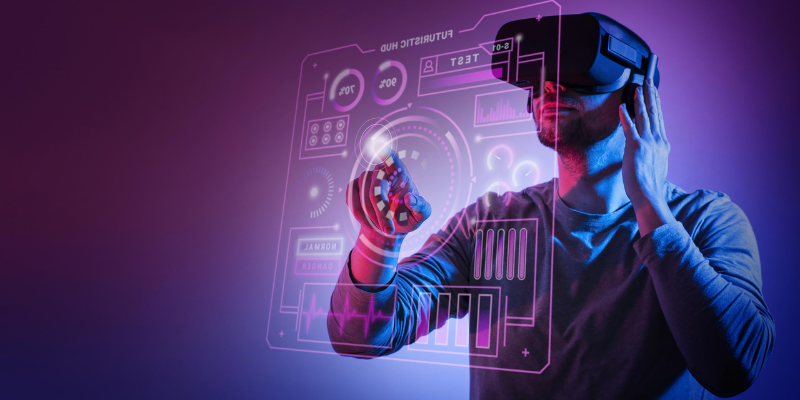
Technology is evolving faster than ever, and at the heart of this innovation is the fusion of Artificial Intelligence (AI) with immersive technologies like Augmented Reality (AR) and Virtual Reality (VR). While augmented reality superimposes digital material on the real environment and VR creates entirely virtual environments, AI enhances both by making them more responsive, intelligent, and interactive.
As industries continue to adopt AR and VR for training, healthcare, entertainment, marketing, and education, the integration of AI is unlocking new potential for real-time decision-making, personalized experiences, and greater realism. These advancements are often explored in depth in programs like an AI Course in Ahmedabad, where learners gain practical exposure to how AI enhances immersive technologies. Let’s explore how AI is revolutionizing AR and VR and what this means for the future of human-computer interaction.
Understanding the Basics: AR, VR, and AI
Before diving into the synergy between AI and immersive technologies, it’s helpful to distinguish them:
- Augmented Reality (AR) incorporates digital components into the physical environment via devices like smartphones or AR glasses. Think of Instagram filters or IKEA’s app that shows how furniture looks in your home.
- Virtual Reality (VR) creates entirely artificial environments where users can interact with virtual objects. This is often experienced through headsets like Oculus or HTC Vive.
- Artificial Intelligence (AI) enables machines to mimic human intelligence—learning, reasoning, predicting, and improving over time.
When these technologies intersect, the result is more dynamic, adaptive, and lifelike virtual experiences.
AI Enhances Real-Time Tracking and Object Recognition
One of the most significant challenges in AR and VR is tracking user movements and recognizing objects in real time. AI improves this through machine learning algorithms and computer vision techniques that allow devices to understand and adapt to the environment.
For example, in AR applications, AI can help identify and label real-world objects so digital content interacts with them more accurately. This is crucial in industries like retail and manufacturing, where AR is used for training or inventory management. In VR, AI enhances spatial awareness, enabling simulations that adjust based on the user’s position, gaze, and gestures. These capabilities are often explored in an AI Course in Kolkata, where learners gain hands-on experience with computer vision and real-time environment mapping.
Personalized User Experiences
AI allows AR and VR systems to learn from user behavior, creating tailored experiences based on preferences and habits. In gaming, for instance, AI can adapt difficulty levels in VR environments depending on a player’s skill. In education, AI-driven AR apps can personalize lessons, making learning more effective and engaging.
This personalization extends to marketing as well. Brands use AI-powered AR to let customers virtually try products—like makeup or clothing—while the system learns what styles or colors they prefer, improving product recommendations and customer satisfaction.
Natural Language Processing (NLP) and Voice Recognition
The integration of Natural Language Processing enables AR and VR systems to understand and respond to voice commands, creating more intuitive and hands-free interaction. AI allows these systems to recognize accents, context, and sentiment—making conversations with virtual assistants or NPCs (non-player characters) more lifelike and engaging.
This is particularly valuable in healthcare or remote training, where professionals need to operate hands-free while receiving instructions or interacting with digital environments. Learners enrolled in AI Courses in Gurgaon gain expertise in developing such hands-free AI solutions, which are transforming industries by enabling more efficient and intuitive interactions with technology.
AI-Powered Analytics in Virtual Environments
In enterprise and training settings, AI analyzes how users interact within AR and VR environments to gather insights. These insights help organizations optimize their virtual workflows or learning experiences.
For instance, in a VR-based employee training module, AI can track how users perform tasks, how long they take, and what areas they struggle with. This data is used to improve future modules, making training more efficient and targeted. Just as it refines training processes, the role of AI in financial forecasting involves analyzing historical data and predicting trends to support smarter business decisions.
Realistic Environments with AI-Generated Content
AI is playing a key role in generating hyper-realistic content for VR. Through generative AI models, virtual environments can now be auto-generated based on user input or training data, saving countless hours in manual design.
In AR, AI allows digital elements to respond more naturally to changes in lighting, angles, and user perspective. This creates seamless blending between the real and digital worlds, increasing immersion and believability.
Enhancing Social and Collaborative Experiences
AI-driven avatars and virtual assistants can interact with users in social VR spaces, adding emotional intelligence and context awareness. These agents can mimic human expressions, adapt speech, and understand tone—making collaborative environments like virtual classrooms or meetings feel more real.
Imagine attending a VR meeting where your AI assistant takes notes, analyzes sentiment in the conversation, and provides summaries or action points afterward. These capabilities are becoming increasingly feasible thanks to AI, and learners in AI Courses in Mumbai are gaining the skills to develop such advanced AI-driven applications for VR environments.
Real-World Applications
Here are a few real-world applications that showcase AI’s influence on AR and VR:
- Healthcare: Surgeons use AI-powered AR to overlay real-time data during operations, and VR simulations train them through AI-guided feedback loops.
- Retail: Virtual try-on apps use AI to detect body dimensions and preferences.
- Education: AR/VR powered by AI allows interactive, adaptive learning tailored to each student’s pace.
- Gaming: AI creates dynamic, intelligent gameplay where environments and characters respond unpredictably to players’ actions.
The Road Ahead
As 5G networks expand and edge computing becomes more accessible, the capabilities of AI-enhanced AR and VR will only grow. We can expect to see more real-time interaction, ultra-realistic simulations, and AI companions that learn and evolve with users over time.
Enterprises that embrace this convergence will gain a competitive edge—especially in training, customer experience, and operational efficiency. Meanwhile, consumers will enjoy more immersive, intelligent, and personalized digital interactions. Similar innovations are seen in the use cases of Artificial Intelligence in cybersecurity, where AI enhances threat detection, automates responses, and strengthens digital resilience across platforms.
AI as the Driving Force Behind Next-Gen Immersive Tech
AI is not just an add-on to AR and VR—it’s the engine driving the next generation of immersive technology. By enabling smarter tracking, realistic environments, and personalized interactions, AI is turning static digital spaces into responsive, evolving experiences.
Whether you’re a developer building virtual worlds or a business leader exploring immersive tech, understanding how AI enhances AR and VR is essential to staying ahead. The distinctions between the real and virtual worlds are becoming increasingly hazy AI ensures that those experiences are not just impressive—but intelligent, adaptive, and deeply human.